|
Manufacturing and service-related businesses are heavily dependent on office
and administrative processes, which can add up to 40-70% of all costs associated with meeting customer demand.
Leaning out office environments starts by engaging the employees to see the waste
in the office processes and to empower them through kaizen teams to eliminate non-value waste to create a competitive
advantage. One of the most common misconceptions
about doing Lean in the office is that there is a different set of Lean tools for the office. Many times organizations
will ask "How can we do kaizen in the office when everything we do is non-standard?"
Once a company embarks on a Lean transformation
in the office, most organizations are shocked by the day-to-day inefficiencies that are discovered just in communication and
information flow. These inefficiencies significantly affect the total product or service lead-time and the company’s
ability to create and deliver its “value-added” service or product to the customer on time, at a lower cost and
with high quality.
|
|
|
Utilize Value Stream Mapping or Swim Lane Mapping Process
|
Organizations
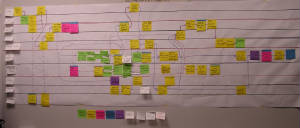
should start on its Lean Office journey by creating a Value Stream Map or Swim Lane Process Map of an entire process –
whether it be a manufacturers office, service providers, government agencies, health care, etc. You will need to observe and
measure, map and analyze the office’s processes like, sales quote and order handling, design/engineering processes,
approvals, financial accounting and material procurement. Each of these processes can be done in a few days or up to a week.
Value Stream Mapping (VSM) or Swim Lane Process Mapping (SLPM) helps everyone to see the flow and take a hard, objective
look at what it is they do every day that impacts the value stream – both negatively and positively. It also forces
people to look at how they manage their gaps and handoff information.
A value stream map (AKA end-to-end system map) takes into account not only the activity
of the product or service, but the management and information systems that support the basic process. The basic idea
is to first map your process, then above it map the information flow that enables the process to occur. Value Stream Mapping
is designed to help Lean teams identify opportunities to remove waste and non-value-adding activities from processes so that
organizations can produce and deliver the products and services to customers more rapidly and at lower cost. Swim lane Process maps very explicitly show the organization structure, and the map arranged on a table where the
rows indicate the “who” does the process step (the “who” could be an individual, a department, or
an organization). The advantage of this mapping approach is when the process flows change “lanes” it indicates
a hand-off. This is where lack of coordination and communication can cause process problems. It also shows
who sees each part of the process. Clear distinctions can be made between the back-office, and those process
steps where customer interactions occur. Both mapping processes
(VSM and SLPM) are used to identify waste and non-value added activities, which can then be attacked to create a more competitive
process. At Leanovations, we recommend starting with
a 3-M post it notes on large brown paper, or use a white-board that can print a copy of the VSM or WLPM, and then moving to
eVSM software program to dynamically digitize, perform calculations and track progress and results through eVSM.
Fred Shamburg, President 83 Boxwood Row, Cheshire, CT 06410
Phone: (860) 479-0293
info@leanovations.com LEANOVATIONS LLC
IS A: Certified Veteran Owned Business Certified Small Business Entity (SBE) Federal Contracting CAGE # Code: 6ZNK8/DUNS #: 017868214 NAICS
#: 541611 (Administrative and General Management Consulting Services) |